Swing Trade
A Stock Trading Strategy
SPONSOR:
The trend is your friend! Click here to see the Top 50 Trending Stocks.

A swing trade is when a trader finds a trending stock and buys at a pullback before the price begins to move again.
A trader can get a good sense of whether a stock is potentially in a pullback by using one or two
moving average
lines to identify either an upward or downward trend, and waiting for a small reversal. A swing trader then takes a trading position by reading the price action just as the stock resumes along the predominant trend.
Swing trading is a popular method of strategy and there’s a reason why – it has a strong probability factor in it’s favor. Before swing traders participate in trading a stock, it has already proven that it’s got a trend going with some momentum.
In a long position, as attention to an upward moving stock grows, more buyers continue to be attracted to it and get into the stock causing the price to keep increasing with a few breathers in between.
After about four or five series of upward movements, the glitter starts to wear off when the value or price of the stock becomes exhausted and unsustainable. This is when a pullback turns into a decline. On the short side, after a good stock declines for an extended time, people start to think - wow, here's a really cheap stock and the trend reverses.
So the trick to profits with swing trading is to be ready with a clear and somewhat tight exit strategy, and don't worry about it bouncing back up, because you can easily get back in for more profits if it or another stock in your watch portfolio sets up.
Swing Trading Strategy - Long Position Overview
What kind of stock (parameters): U.S. large cap or stocks with volume over 500,000 shares traded daily, trading above 50 and 200-day moving averages for a long position and below 50 and 200-day moving averages for a short position
What’s used (probabilities): moving averages, candlesticks, Williams %R, ADX
Market direction: trending up (long) or down (short)
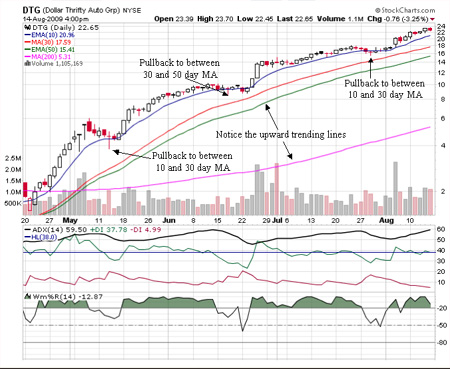
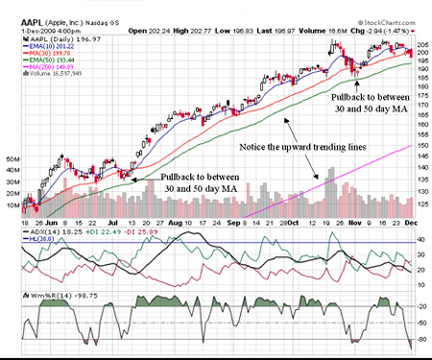
What to look for (setup): stock in a upward trend (10 or 20 day over 50-day) at a pullback, look for stocks hitting a 52-week high as potential candidates; wait for the price to cross down between the 10-day and 30-day MAs.
Entry: After at least 3 consecutive days down toward the 30-day moving average look for a candlestick with a tail and set a buy price above the high of that day.
Exit: place a stop at the previous day’s low or trail stop on a 5 or 6-day EMA
It may appear in the long examples below that one shouldn't have sold at all. However, you can't predict what price is going going to do so it's a bit of a defensive move to sell and lock in a profit. You will protect against unnecessary loss and you can also get back into the stock. The cost of the trade is a small insurance premium.
Examples:
Notice on the the chart below of DTG that within the indicated pullback area there are candlesticks in the form of a doji which is a candlestick of indecision.
Swing Trading Strategy - Short Position Overview
Similarly, if you are comfortable shorting stocks and the market is trending down, you would look for the opposite of the setup for a long swing trade. That would be a stock trading below the 200-day moving average that has attempted to rally past the 10 or 30-day moving average, but failed. Look for that same kind of indecision in a candlestick and then short the stock.
What kind of stock (parameters): U.S. large cap or stocks with volume over 500,000 shares traded daily, below 50 and 200-day moving averages for a short position
What’s used (probabilities): moving averages, candlesticks, Williams %R, ADX
Market direction: trending down (short)
What to look for (setup): stock in a downward trend (10-30 day below 50-day) at a small rally, look for stocks hitting a 52-week low as potential candidates
Entry: Look for a short position after 3 consecutive days up toward the 30-day moving average look for a bearish candlestick
Exit: place a stop at the previous day’s high or trail on a 5 or 6-day EMA
One of the nice things about swing trading is that once you identify stocks that fit the criteria and are trending, you can keep a "herd" of potential swing trading candidates in a watch portfolio until you see something that signals you to take action.
Using a swing trade strategy is one of several good
stock trading strategies
you can implement.
If you're interested in how to determine market direction before making any trades click on -
Stock Market Trend.
For strategies on position sizing your swing trades click on -
Stock Market Portfolio.
Return
from Swing Trade to Online Stock Trading Warrior Home.